
First Call to Action:
May 28 – International Day of Action for Women’s Health has long served as a rallying point for movements around the world that defend and advance the health, rights, and well-being of women in all their diversity. Ahead of the upcoming 2026 campaign, advocates, including SRHR activists, will gather at a critical moment—shaped by converging political, economic, and social crises that challenge progress, while creating opportunities for collective resistance and renewed action.
Women’s health and sexual and reproductive health and rights (SRHR) are inherently tied to political, economic, and social realities. In 2026, these interconnected issues are increasingly reshaping health systems, deepening inequities, and disproportionately impacting marginalized communities, including young people, women, and gender-diverse individuals. Political decisions, economic policies, and global development agendas are redefining who can access health services and under what conditions, with structural inequalities often determining who is left behind.
These global dynamics intersect with national-level realities, including high debt burdens, IMF-driven austerity measures, and constrained fiscal space, which significantly limit public investment in health systems. As a result, the availability, accessibility, and quality of essential SRHR services are compromised, particularly for women and young people. Persistent gender inequities, systemic discrimination, and the erosion of protections for diverse identities continue to influence health outcomes. In many contexts, challenges extend beyond availability of services to include the quality and dignity of care. Obstetric violence—including disrespect, abuse, coercion, and neglect during childbirth—remains widespread, yet is often under-recognized as a form of gender-based and systemic violence.
At the global level, health governance is undergoing significant shifts, with health increasingly treated as a tool of geopolitical strategy. The America First Global Health Strategy (AFGHS) exemplifies this trend, prioritizing political and commercial interests over evidence-based needs and undermining equitable access to essential health services in the Global South. Consequently, life-saving healthcare—including SRHR, maternal health, mental health, gender-based violence response, and safe, legal abortion care—is increasingly being deprioritized.
The reinstatement and expansion of the Global Gag Rule (GGR) further restricts funding for organizations that provide abortion-related services or advocacy, resulting in clinic closures, reduced services, and increased barriers to care. IIn parallel, shrinking civic space, political polarization, and democratic backsliding are limiting advocacy and accountability, making it more difficult to defend and expand health and rights. These pressures are compounded by chronic underinvestment in women’s health, reflected in persistent health gaps, with women spending a greater proportion of their lives in poor health and remaining underserved by research, funding, and innovation.
Economic pressures further intensify these challenges. Reduced public investment, coupled with privatization of healthcare systems, increases reliance on out-of-pocket spending and shifts the burden of care onto households—disproportionately affecting women in all of their diversity. Limited and unequal access to modern contraceptives—particularly for adolescents and young people—continues to drive unintended pregnancies, unsafe abortions, and restricted life choices, often shaped by restrictive policies, provider bias, and harmful social norms. Rising inflation, debt pressures, and global economic instability further constrain both governments and individuals in accessing and delivering care.
Climate change, environmental degradation, and forced displacement create further health risks, particularly for those already marginalized. Community-based and informal care systems—often led by women in all of their diversity—continue to play a critical role in sustaining health and well-being in the face of weak formal systems; however, these systems remain under-resourced and undervalued.
These pressures are further intensified by militarization, wars, and refugee crises, which disrupt health systems and expose women, girls, and gender-diverse individuals to heightened risks of violence and denial of care. In this context, women and marginalized groups—including LGBTQ+ communities, migrants, Indigenous peoples, and people with disabilities—experience compounded forms of exclusion that heighten health risks and limit access to essential services. These intersecting challenges underscore that women’s health is not only a service delivery issue, but a matter of power, justice, and accountability.
At the same time, recent developments highlight the growing influence of well-funded anti-rights actors—including right-wing, nationalist, religious fundamentalist, and authoritarian forces—demonstrating that hard-won gains in health and rights remain fragile. These actors are increasingly reversing decades of progress by shaping policies, spreading misinformation, co-opting human rights language to legitimize regressive agendas, and occupying positions of power. Efforts to roll back diversity, equity, and inclusion (DEI) initiatives, alongside the removal or dilution of references to “women,” “gender,” and “SRHR” in policies and public discourse, reflect a broader pattern of erasure that limits recognition of lived realities and undermines rights. These actions pose a serious threat to the health, dignity, and rights of women and marginalized communities, making sustained advocacy, solidarity, and collective action more urgent than ever.
Despite these challenges, feminist movements, youth leaders, and grassroots communities around the world are not only responding, but also actively challenging harmful narratives, demanding accountability from governments and institutions, and building models of care rooted in justice, dignity, and collective well-being. Their leadership remains essential in advancing a future grounded in equity, rights, and transformative change.
Why the 2026 Global Consultation Matters
The May 28 Global Consultation is a vital opportunity to collectively examine these emerging political, economic, and social challenges, and understand their implications for women’s health in all of their diversity. Through pre-consultation survey inputs, participants will help identify and validate emerging issues, prioritize agendas, and share context-specific experiences and resources.
The consultation will:
- Provide a platform to analyze political, economic, and social factors affecting SRHR and women’s health.
- Facilitate knowledge exchange across regions on context-specific challenges and promising strategies.
- Enable participants to prioritize issues for advocacy and set a unified global agenda for May 28 and in line with the International Conference on Population and Development (ICPD) Programme of Action commitments and SDG 2030 commitments.
- Contribute to the development of key messages, campaign materials, and a comprehensive Call to Action that amplifies diverse voices.
We invite organizations, activists, and advocates across movements to become May 28 Campaign Partners. By participating, you will help shape a global agenda for action, strengthen alliances, and ensure that women’s health and SRHR remain central to development, justice, and equity.
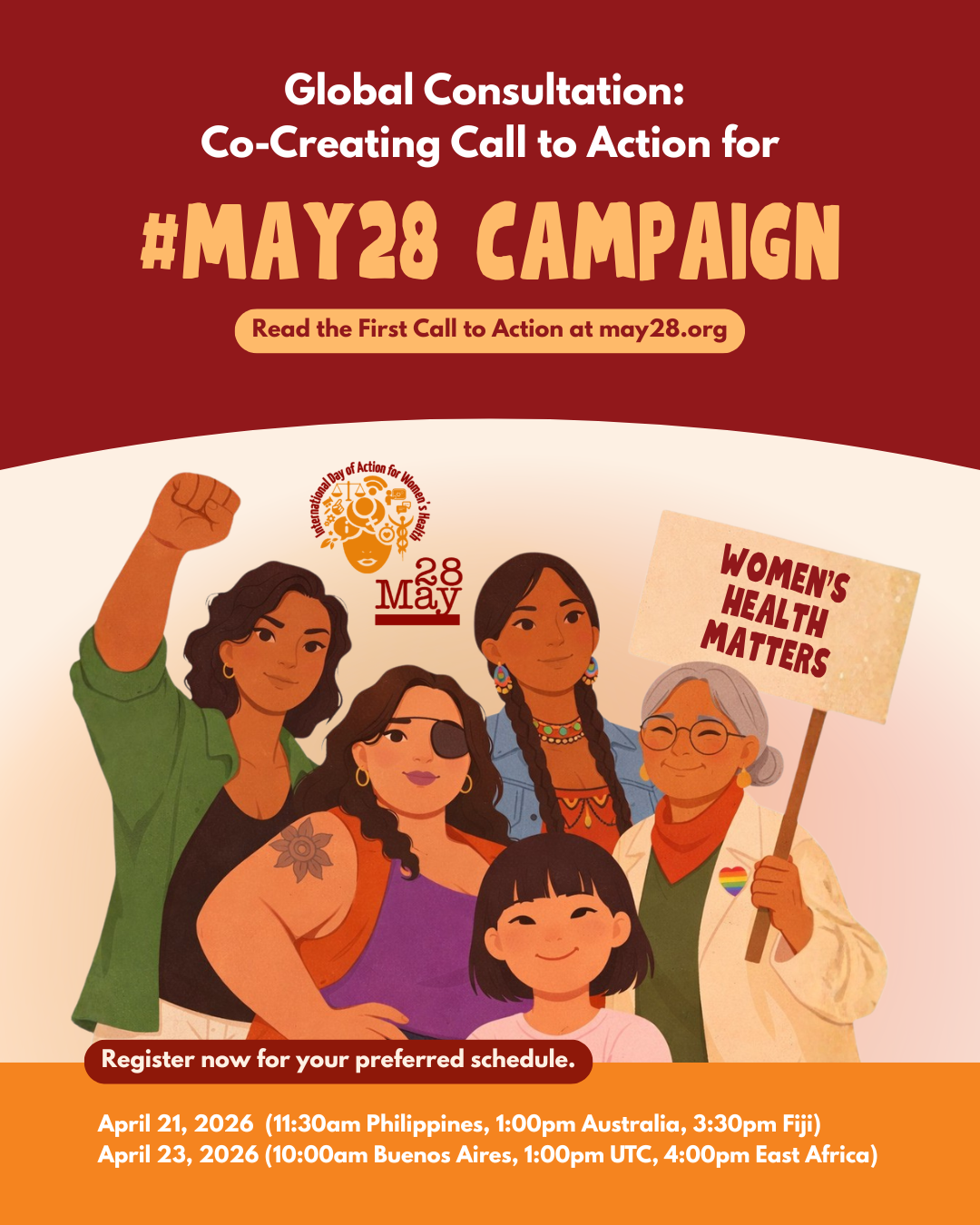
Register now for your preferred schedule.
- April 21, 2026 (9:00am India, 11:30am Philippines, 1:00pm Australia, 3:30pm Fiji) – works better for Asia and Pacific
- April 23, 2026 (10:00am Buenos Aires, 1:00pm UTC, 2:00pm West Africa, 4:00pm East Africa) – works better for Africa, Europe, North America, and LAC.